
Health Calculators
Determine your body shape based on your measurements, including bust, waist, high hip, and hip measurements. Useful for fashion choices and health assessments.
Shoppers, stylists and home sewers use body shape categories to pick cuts that balance proportions, choose patterns that need fewer alterations, or understand why certain jeans fit better than others. Enter four tape measurements and the calculator compares your bust, waist, high hip and hip to assign one of seven shapes, such as Hourglass, Rectangle, Triangle or Spoon. It also reports your waist-to-hip ratio, a number some people track alongside other health measures. The shape label describes proportions only; it says nothing about how healthy or attractive a body is.
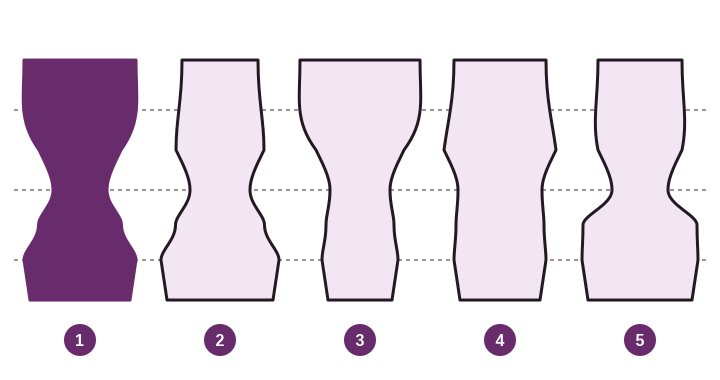
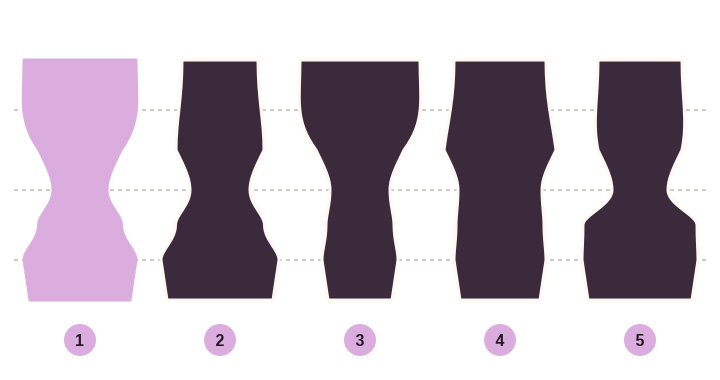
The main shapes the calculator can return, compared along the same bust, waist and hip lines. Top and bottom hourglass are variants of the first shape.
Where:
A 36 in bust, 24 in waist, 32 in high hip and 36 in hips (the calculator's default inputs).
Bust and hip difference
Bust curve
Waist-hip ratio
Result
The body type is Hourglass, with a waist-hip ratio of 0.67. For a woman, 0.67 is below the 0.85 cut-off, so the waist-hip health risk is Not increased.
Compare your bust, waist and hip measurements. Bust and hips within about 1 inch of each other with a waist 9 or more inches smaller suggests an Hourglass, while hips 3.6 or more inches larger than the bust with a less defined waist suggests a Triangle (pear). This calculator applies those kinds of rules automatically.
This calculator can return seven shapes: Hourglass, Top Hourglass, Bottom Hourglass, Spoon, Triangle, Inverted Triangle and Rectangle. If your measurements do not match any rule, it shows No clear match. The categories come from fashion and sewing fit systems rather than medicine.
Both have hips larger than the bust. A Spoon has a defined waist and a high hip that is noticeably wider than the waist (a high hip to waist ratio of 1.193 or more), creating a shelf-like hip. A Triangle has hips at least 3.6 inches larger than the bust but a waist less than 9 inches smaller than the hips.
The World Health Organization uses a waist-to-hip ratio above 0.85 for women and above 0.90 for men as a marker of increased health risk. A 28 in waist with 38 in hips gives a ratio of 0.74. It is one screening measure and is best read alongside others.
Your skeletal frame stays the same, but weight change, muscle gain, pregnancy, aging and menopause can all shift where fat is stored and change your measurements. Re-measuring after a significant change can give a different result.
Either works. Each field has its own unit selector, and centimeter values are converted to inches before the shape rules are applied, so 91 cm and 36 in give the same result.
Enter your bust, waist, high hip and hip measurements in inches or centimeters to see your body shape and waist-to-hip ratio.