
Health Calculators
Discover your BMI effortlessly with our intuitive calculator app. Understand your weight status and health risks in seconds. Take control of your health today!
BMI is the quick screening number used by doctors, insurers, fitness apps and public health guidelines to sort adults into weight categories. It helps you answer a simple question: is my weight in the range usually linked with lower health risk for my height? The result shows your BMI to one decimal place and the matching adult category, from Underweight below 18.5 to Obese at 30 and above. Because BMI cannot tell muscle from fat or show where fat is stored, it works best as a starting point that you read alongside waist size and other health measures.
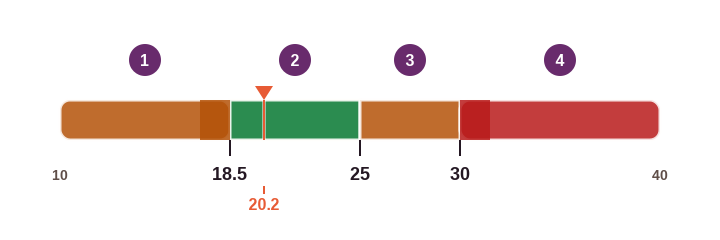
The four BMI categories the calculator reports, with the example result of 20.2 marked. The boundaries are the standard adult cut-offs.
Where:
An adult who weighs 50 kg and is 5 ft 2 in tall (the calculator's default inputs).
Height in meters
Height squared
BMI
Classification
Result
The BMI is 20.2, which falls in the Normal Weight category (18.5 to 24.9). At 5 ft 2 in the healthy weight range is 45.9 to 61.8 kg, so the change needed is 0 kg.
BMI equals weight in kilograms divided by height in meters squared. For someone who weighs 70 kg and is 5 ft 9 in (1.753 m) tall, that is 70 ÷ 3.072 = 22.8. In pounds and inches the equivalent formula is 703 × weight in lb ÷ height in inches squared.
For adults, the World Health Organization and the CDC treat a BMI of 18.5 to 24.9 as the healthy (normal) range. At 5 ft 9 in, that range works out to roughly 57 to 76 kg (126 to 168 lb). Some health bodies use lower cutoffs for people of Asian descent because health risks can rise at a lower BMI.
For adults aged 20 and over, the same BMI categories apply at every age, so 18.5 to 24.9 is considered the healthy range whether you are 25 or 65. Some research suggests a slightly higher BMI may not carry extra risk in older adults, but the standard categories do not change. Children and teens are assessed with age- and sex-specific BMI percentiles, which this calculator does not compute.
Yes. Under the standard adult categories, a BMI of 25.0 to 29.9 is classed as Overweight, and this calculator switches from Normal Weight to Overweight at exactly 25. For example, 80 kg at 5 ft 10 in gives a BMI of 25.3, which shows as Overweight.
BMI is a useful population-level screening tool, but it does not measure body fat directly. Very muscular people can be classed as overweight while having low body fat, and older adults can have a normal BMI with relatively high body fat. Waist circumference, body fat percentage and a clinician's assessment give a fuller picture.
No. The adult BMI formula and cutoffs are the same for men and women, which is why this calculator only asks for weight and height. Women tend to carry more body fat than men at the same BMI, which is one reason BMI is best read alongside other measures.
Enter your weight in kilograms and your height in feet and inches to see your BMI and weight category.