
Date Calculators
Find sunrise and sunset times, solar noon, civil twilight, golden hour, blue hour and day length for any city and date, shown in the city's local time using the NOAA solar equations.
Pick a city and a date to see when the Sun rises and sets there, how long the day lasts, and when the soft light photographers look for begins and ends. The calculator follows the NOAA solar equations: it finds the Sun's declination and the equation of time for that day, works out solar noon from the city's longitude, then measures how long before and after noon the Sun crosses each altitude that matters: −0.833° for sunrise and sunset, −4° and +6° for golden hour, and −6° for civil dawn and dusk. Every time is shown in the city's own time zone, including daylight saving time, so you can plan a sunrise hike, a golden-hour shoot or a blue-hour long exposure without converting anything. Above the Arctic and Antarctic circles it tells you when the Sun never sets or never rises.
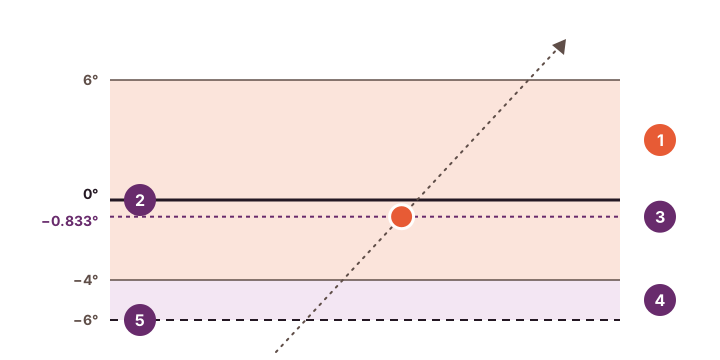
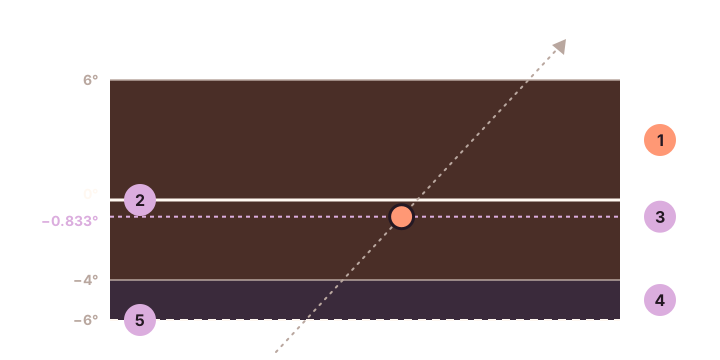
The sun altitudes the calculator times. Sunrise and sunset happen when the Sun's centre crosses −0.833°, just below the horizon, because refraction and the Sun's radius make its top edge visible first.
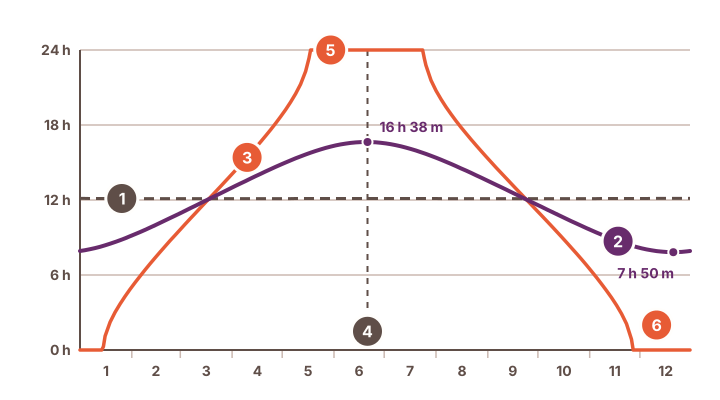
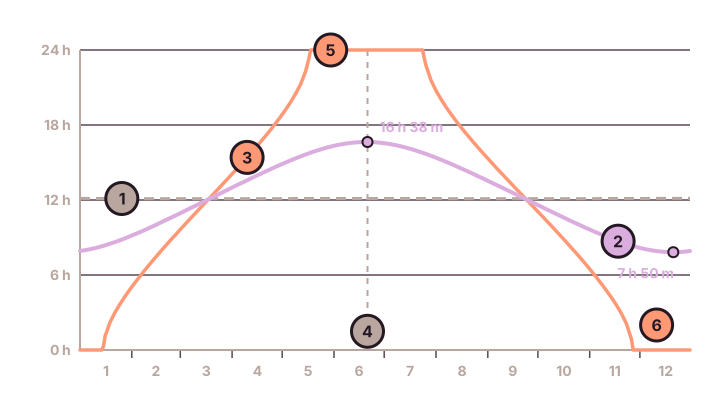
Hours of daylight through the year (months 1 to 12) at three latitudes. Near the equator every day lasts about 12 hours; the farther from it, the bigger the swing between winter and summer, until above the Arctic Circle the Sun stays down or up for weeks.
Where:
London (51.5074° N, 0.1278° W) on 21 June 2024, the calculator's default city. That day the Sun's declination is 23.437° and the equation of time is −1.93 minutes; London is on BST (UTC+1).
Solar noon: 722.44 minutes after midnight UTC is 12:02 UTC, or 13:02 BST (782.44 minutes)
Hour angle for the sunrise altitude of −0.833° (the fraction is −0.5706)
Sunrise and sunset in BST, 4 × 124.79 = 499.16 minutes either side of noon
Result
Sunrise is at 04:43 BST and sunset at 21:21 BST, so the day lasts 16h 38m. The calculator repeats these steps at each event's own time, which moves the results by a few seconds but not the minute shown.
On 21 June 2024 the Sun rose in London at 04:43 BST and set at 21:21 BST, giving 16h 38m of daylight. On 21 December 2024 it rose at 08:04 GMT and set at 15:53 GMT, a day of about 7h 50m. Solar noon moved from 13:02 BST in June to 11:58 GMT in December.
Sunrise and sunset are timed when the top edge of the Sun touches the horizon, not its centre, and the atmosphere bends light so the Sun looks about half a degree higher than it is. Together these put the Sun's centre at −0.833° at sunrise and sunset, which adds a few minutes at both ends. In London on 20 March 2024 the Sun rose at 06:02 and set at 18:14, a day of 12h 12m. Even in Quito, on the equator, the day lasts 12h 7m to 12h 8m all year.
Golden hour is when the Sun is low, between 4° below and 6° above the horizon, so the light is warm and shadows are long. Blue hour is the deeper twilight next to it, with the Sun 4° to 6° below the horizon. In London on 21 June 2024 the evening golden hour ran from 20:27 to 21:49 BST and the blue hour from 21:49 to 22:09. Near the equator the Sun drops steeply, so both are shorter: in Quito the evening golden hour lasts about 44 minutes.
If the Sun never drops below −0.833°, the sunrise and sunset rows read No sunrise today and No sunset today, the day length is 24h and a note marks a polar day. In Tromsø (69.6° N) on 15 June 2024 the morning golden hour ends at 02:58 and the evening one starts at 22:32 and lasts through the night, and there is no blue hour because the Sun never sinks below −4°. On 27 November 2024 Tromsø has a polar night: the day length is 0m, but civil twilight still lasts from 08:37 to 14:25.
Solar noon is the moment the Sun is highest. It depends on where the city sits inside its time zone, on daylight saving time and on the equation of time, which moves it by up to about 16 minutes over the year. London, almost on the Greenwich meridian, has solar noon at 13:02 BST on 21 June 2024. Madrid lies far west of the Central European Time meridian, so its solar noon that day is 14:16 and the Sun does not set until 21:48.
The NOAA equations agree with published almanac times to within about a minute between 72° N and 72° S. For New York on 21 December 2024 they give sunrise at 07:16 and sunset at 16:32 EST. What you actually see can differ by a few minutes because of hills or buildings on the horizon, your elevation, and unusual refraction near the poles. Times are rounded down to the minute.
Choose a city and a date to get that day's sunrise, sunset and twilight times in local time.