
Overview

Find the Moon's phase, the percentage of its disc lit by the Sun and its age in days for any date, plus the exact times of the next new moon, first quarter, full moon and last quarter in your city's local time.

Choose a date and, if you like, a city to see which phase the Moon is in, how much of it is lit and how many days have passed since the last new moon. The calculator works out where the Moon and the Sun sit on the sky from the lunar and solar theories in Jean Meeus's Astronomical Algorithms, measures the angle between them, and turns that angle into the lit fraction of the disc. A day is named after a principal phase (new moon, first quarter, full moon or last quarter) when that phase's exact moment falls on the chosen date in the city's time zone; on the other days it is a crescent or gibbous Moon, waxing or waning. Below the phase it lists the next four principal phases with their date and time, so you can plan a night of stargazing, a full-moon walk or a dark sky for astrophotography.
Formula and example

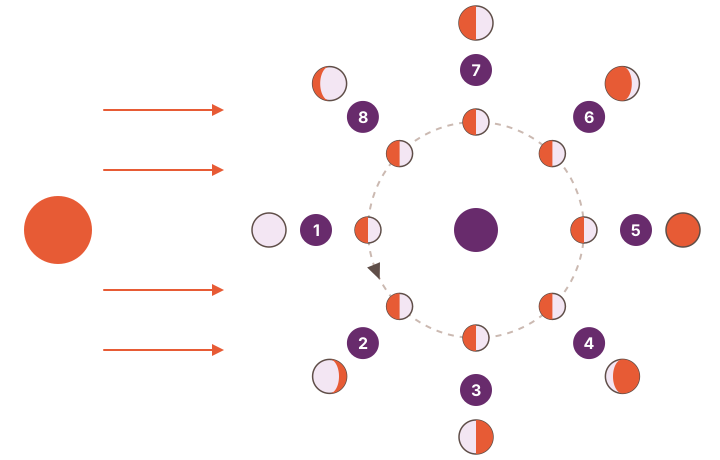
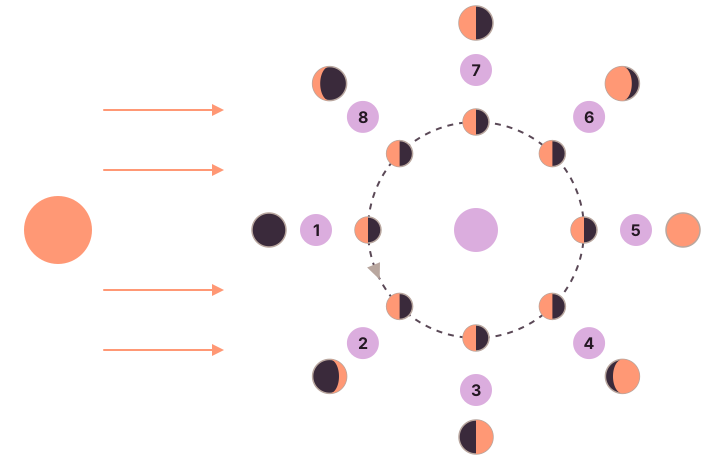
The Sun on the left sends parallel rays of light towards the Earth in the centre. Eight Moons sit on a dashed circular orbit around the Earth, each lit on the half that faces the Sun, with an arrow showing the orbit runs anticlockwise. Outside each one a second disc shows how that Moon looks from Earth: dark on the Sun side, a thin crescent lit on the right, a half lit on the right, a gibbous lit on the right, fully lit opposite the Sun, then gibbous, half and crescent lit on the left.

Why the Moon has phases: the Sun always lights half of the Moon, and as the Moon orbits the Earth once every 29.5 days we see more or less of that lit half. Inner ring: the Moon in its orbit, seen from above the North Pole. Outer ring: how it looks from the northern hemisphere.

  1. New Moon: between the Earth and the Sun, its lit side faces away (0%)
  2. Waxing Crescent: a thin sliver lit on the right
  3. First Quarter: 90° from the Sun, right half lit (about 7.4 days old)
  4. Waxing Gibbous: more than half lit, growing
  5. Full Moon: opposite the Sun, the whole face lit (about 14.8 days old)
  6. Waning Gibbous: more than half lit, shrinking
  7. Last Quarter: left half lit (about 22.1 days old)
  8. Waning Crescent: a thin sliver lit on the left before the next new moon
cos⁡Elong=cos⁡Moon latcos⁡(Moon long−Sun long)\displaystyle \cos \text{Elong} = \cos \text{Moon lat} \cos(\text{Moon long} - \text{Sun long})
tan⁡Phase angle=Sun distsin⁡ElongMoon dist−Sun distcos⁡Elong\displaystyle \tan \text{Phase angle} = \frac{\text{Sun dist} \sin \text{Elong}}{\text{Moon dist} - \text{Sun dist} \cos \text{Elong}}
Lit=1+cos⁡Phase angle2\displaystyle \text{Lit} = \frac{1 + \cos \text{Phase angle}}{2}
Age=Noon−New moon\displaystyle \text{Age} = \text{Noon} - \text{New moon}

Where:

Elong
— The elongation: the angle between the Moon and the Sun as seen from the Earth, 0° at new moon and close to 180° at full moon.
Moon lat
— The Moon's ecliptic latitude, how far it sits above or below the Sun's path, at most about 5.3°.
Moon long
— The Moon's apparent ecliptic longitude, from the 60 largest periodic terms of the lunar theory in Meeus's Astronomical Algorithms.
Sun long
— The Sun's apparent ecliptic longitude. When the Moon's longitude is 0°, 90°, 180° or 270° ahead of it, the Moon is at new moon, first quarter, full moon or last quarter.
Phase angle
— The angle at the Moon between the Sun and the Earth: 0° when the Moon is fully lit as seen from Earth and 180° when it is dark.
Sun dist
— The distance from the Earth to the Sun, about 147 to 152 million km over the year.
Moon dist
— The distance from the Earth to the Moon, between about 356,000 and 407,000 km.
Lit
— The illuminated fraction of the Moon's disc, shown as a percentage.
Noon
— 12:00 noon on the chosen date in the city's time zone, the moment the phase is read.
New moon
— The exact moment of the most recent new moon, found by solving for the instant the Moon's longitude equals the Sun's.
Age
— The Moon's age in days since that new moon.

Worked example

London on 25 January 2024, read at 12:00 GMT. At that moment the Moon's longitude is 122.242°, its latitude 4.870° and its distance 400,403 km (0.4004 million km); the Sun's longitude is 304.999° and its distance 147.27 million km.

  1. Elongation from the two longitudes and the Moon's latitude

    cos⁡4.870∘×cos⁡(−182.757∘)≈−0.99524⇒174.41∘\displaystyle \cos 4.870^{\circ} \times \cos(-182.757^{\circ}) \approx -0.99524 \Rightarrow 174.41^{\circ}
  2. Phase angle, with both distances in millions of km

    arctan⁡147.27×0.097490.4004+147.27×0.99524≈5.58∘\displaystyle \arctan \frac{147.27 \times 0.09749}{0.4004 + 147.27 \times 0.99524} \approx 5.58^{\circ}
  3. Illuminated fraction

    1+cos⁡5.58∘2≈0.9976⇒99.8%\displaystyle \frac{1 + \cos 5.58^{\circ}}{2} \approx 0.9976 \Rightarrow 99.8\%
  4. Age, counted from the new moon of 11 January 2024 at 11:57 GMT

    12:00 25 Jan−11:57 11 Jan≈14.0 days\displaystyle 12{:}00\ \text{25 Jan} - 11{:}57\ \text{11 Jan} \approx 14.0\ \text{days}

Result

The Moon is 99.8% lit and 14.0 days old. The exact full moon, 17:54 GMT, falls on 25 January in London, so the day is named Full Moon; the next new moon is on 9 February at 22:59 GMT.

FAQs

When was the full moon in January 2024, and how full was it the days around it?

The full moon was on 25 January 2024 at 17:54 GMT. At noon that day in London the Moon was 99.8% lit and 14.0 days old. Four days earlier, on 21 January, it was a Waxing Gibbous Moon, 82.8% lit and 10.0 days old. The next new moon followed on 9 February at 22:59 GMT.

Why does the phase on a date depend on my city?

Each principal phase is a single instant, but that instant lands on different calendar days in different time zones. The new moon of 30 December 2024 happened at 22:27 UTC, which is 14:27 on 30 December in Los Angeles but 07:27 on 31 December in Tokyo. The calculator names the day New Moon in whichever city's day contains that moment, so Los Angeles shows it on the 30th and Tokyo on the 31st.

Is the first quarter moon a quarter lit?

No. "Quarter" refers to a quarter of the way around the orbit, not to the lit area. At first and last quarter the Moon is 90° from the Sun and you see half of the disc lit. In New York on 8 December 2024, the day of the first quarter, the Moon was 50.9% lit at noon and 7.4 days old.

How long is a lunar month?

From one new moon to the next takes 29.53 days on average, the synodic month. The real gap ranges from about 29.18 to 29.93 days because the Moon's orbit is elliptical. The Moon goes round the Earth in 27.32 days, but the Earth has meanwhile moved along its own orbit, so the Moon needs about two more days to line up with the Sun again.

Why is the Moon never exactly 100% or 0% lit?

The Moon's orbit is tilted about 5° to the Earth's, so at most full and new moons it passes slightly above or below the line from the Sun. At the full moon of 25 January 2024 it was 99.8% lit at noon. It only reaches 100% or 0% at an eclipse: at the new moon of 8 April 2024, the day of the total solar eclipse over North America, it was 0.0% lit.

What is the Moon's age?

The age is the time since the last new moon, in days. It runs from 0 at new moon to about 29.5 just before the next one: about 7.4 days at first quarter, 14.8 at full moon and 22.1 at last quarter on average. The calculator measures it from the exact moment of the previous new moon to 12:00 noon on the chosen date in the city.

How accurate are the phase times?

The phase instants agree with published almanac times to within about two minutes: the calculator gives 17:54 UTC for the full moon of 25 January 2024, 18:21 UTC for the new moon of 8 April 2024 and 11:26 UTC for the full moon of 17 October 2024. Times are shown to the minute in the city's time zone, including daylight saving time.

How to use

Pick a date and a city to see the Moon's phase that day and the dates of the next principal phases.

  1. Pick the dateToday is filled in by default. Choose any day from a hundred years ago to ten years ahead; the result updates as soon as you change it.
  2. Choose a cityLondon is preselected. The city sets the time zone: it decides which calendar day a phase falls on and the local time shown for each upcoming phase.
  3. Read the phase, illumination and ageThe top card shows the phase name, the percentage of the disc lit by the Sun and the Moon's age in days, all for 12:00 noon in the city. On 25 January 2024 in London it reads Full Moon, 99.8% and 14.0 days.
  4. Plan with the upcoming phasesThe table lists the exact date and time of the next new moon, first quarter, full moon and last quarter. Save a scenario, then change the date to compare how the illumination grows and shrinks.

Assumptions

  • Positions come from the truncated lunar theory and the low-accuracy solar theory in Jean Meeus's Astronomical Algorithms (2nd edition), good to about an arcminute; phase times land within about two minutes of published almanacs.
  • Illumination and age are read at 12:00 noon in the city's time zone and are geocentric, as seen from the Earth's centre. Where you stand on Earth shifts the illumination by up to about 1 percentage point near the quarters.
  • A day is named after a principal phase only if that phase's exact moment falls between local midnight and the next midnight; otherwise it is a crescent (under 50% lit) or gibbous (50% or more) Moon, waxing or waning.
  • The phase shapes are the same everywhere, but south of the equator the Moon appears upside down, so a waxing crescent is lit on the left instead of the right.

Explore more