
Guide · Sep 5, 2026
Understand Your BMI and What It Does Not Tell You
Q: What is BMI, in plain language?
BMI (Body Mass Index) is a simple number that compares your weight to your height to estimate weight status. According to the CDC, it’s a quick, low-cost screening tool used widely in public health, not a diagnosis or a judgment about fitness or appearance.
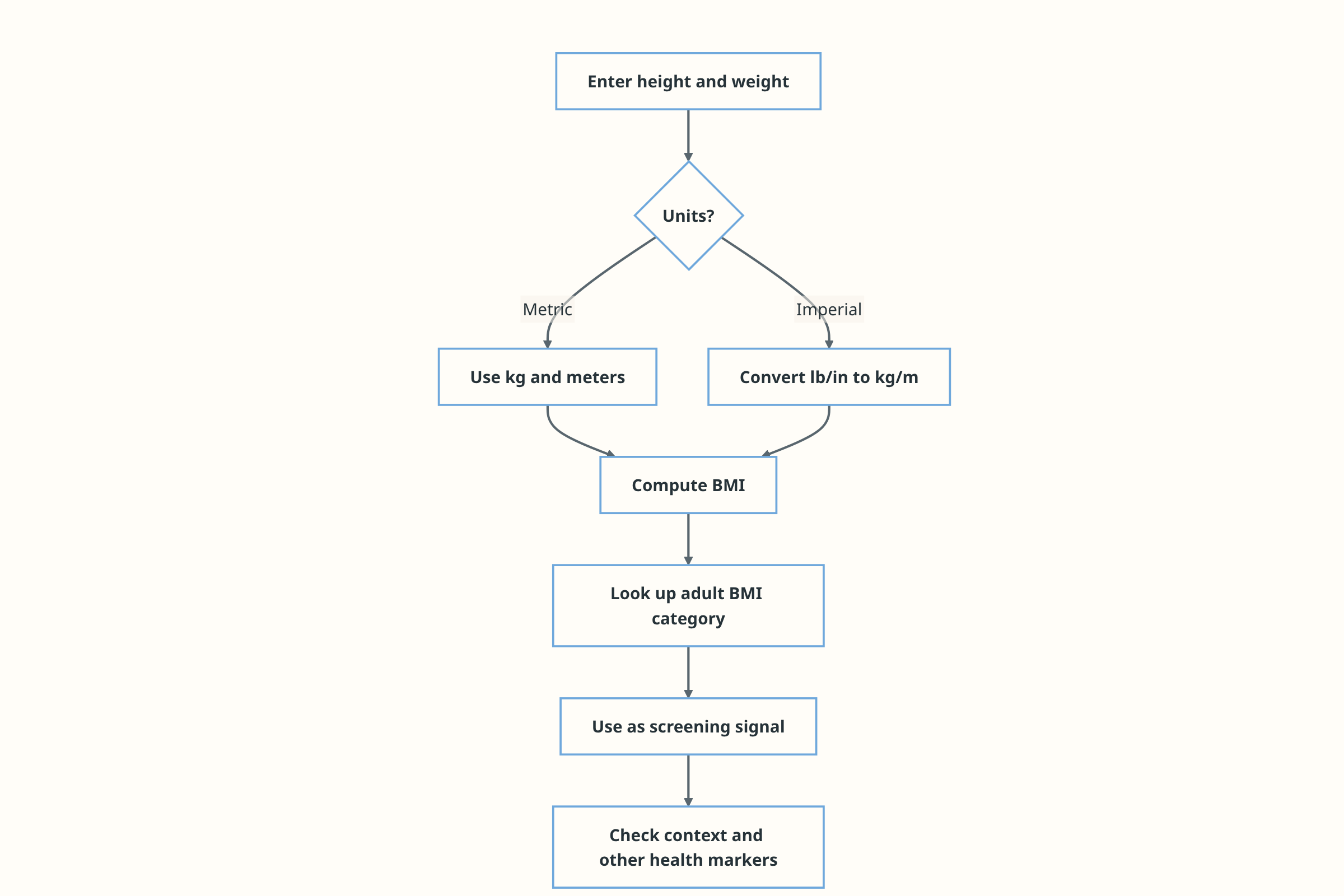
How to use BMI well (mental model):
- Calculate your BMI
- Interpret the adult category (or percentile for kids/teens)
- Check context (muscle, age, pregnancy, etc.)
- Add other health signals (blood pressure, labs, waist, etc.)
Q: How is BMI calculated (and what does “kg/m²” mean)?
According to the CDC, BMI uses this formula: BMI = weight (kg) / height (m)². “m²” means you multiply height in meters by itself. Example: 70 kg and 1.75 m → 1.75² = 3.06, so BMI ≈ 70/3.06 = 22.9. If you use pounds/inches, calculators (including FreeCalculator.io) convert units for you.
Q: What do the adult BMI categories mean?
For adults, BMI categories are standard cutoffs used for screening and public-health comparisons. According to the NHLBI: Underweight (<18.5), Healthy (18.5–24.9), Overweight (25.0–29.9), and Obesity (≥30.0). Treat these as risk signals, not a verdict on your fitness or overall health.
| Adult BMI category (screening) | BMI range |
|---|---|
| Underweight | < 18.5 |
| Healthy weight | 18.5–24.9 |
| Overweight | 25.0–29.9 |
| Obesity | ≥ 30.0 |
For example, a BMI of 29.9 is in the overweight range, just 0.1 below obesity. That tiny difference shouldn’t change your next step—check context and other health markers.
Q: If BMI is only a screening tool, how should I interpret my result?
Use BMI as a direction sign, not a diagnosis. It tells you where to look next. The CDC frames BMI as a quick, low-cost screening measure that can flag possible weight-related risk and prompt a check-in with your overall health.
Practical interpretation tips:
- Don’t panic over tiny differences (rounding and day-to-day weight changes)
- Look at the trend over time, not one reading
- Use cutoffs as prompts, not “cliff edges” (29.9 vs 30.0 is not a sudden health change)
Q: What BMI does not tell you (the big limitations)
Confusion often comes from what BMI can’t measure. According to the CDC, BMI does not directly measure body fat. It also can’t separate fat from muscle or bone (the CDC and NHLBI both stress this), so two people can share the same BMI (one muscular, one with higher body fat). BMI also doesn’t show where fat is carried. More central (belly) fat can raise health risk even at a similar BMI.
Q: Why does BMI say I’m overweight/obese when I’m athletic?
BMI can run high in athletic people because it can’t tell muscle from fat. The CDC notes BMI doesn’t distinguish fat, muscle, and bone, and Cleveland Clinic cautions that standard BMI charts can misclassify athletes/bodybuilders.
Common “athlete mismatch” clues (not a diagnosis):
- You have visibly higher muscle mass (strength training, bodybuilding, some sports)
- You feel fit and perform well physically
- Your blood pressure and labs are normal (as checked by a clinician)
Example: a strength athlete may land in “overweight” while having low body fat and normal blood pressure and labs. In that case, BMI is less a “result” and more a prompt to double-check other measures.
Q: Does BMI work the same for older adults?
Not always. Cleveland Clinic notes standard BMI charts may be less appropriate for adults over 65 because body composition shifts with age. Loss of muscle can raise health risk even when BMI looks “normal,” and BMI may miss frailty or where fat is carried. Per the CDC, interpret BMI alongside other clinical factors, especially with unintentional weight loss, weakness, or chronic disease.
Q: Should I use BMI during pregnancy?
Usually, not by itself. Cleveland Clinic notes pregnancy is a situation where you likely shouldn’t use the standard BMI chart. Because weight and body changes are expected, a single BMI number can be misleading. Use prenatal visits to set clinician-led targets and discuss your starting weight, health history, and any rapid or unusual changes.
Q: Is BMI interpreted differently for children and teens?
Yes. Adults use fixed BMI cutoffs, but for children and teens (starting at age 2) the CDC recommends BMI-for-age percentiles from CDC growth charts.
Adult vs. child/teen BMI at a glance:
| Group | What you use | What the result means |
|---|---|---|
| Adults (20+) | BMI number + fixed cutoffs | Category (underweight/healthy/overweight/obesity) |
| Children/teens (2–19) | BMI-for-age percentile | Compared vs. peers of same age/sex (growth chart context) |
Don’t apply adult categories to kids. Use a child/teen BMI calculator that reports percentile, then discuss results with a pediatric clinician, especially with rapid growth changes or health concerns.
Q: What should I check next besides BMI?
Once you have your BMI number and category, add context. BMI is most useful when you pair it with other health information. The CDC recommends looking at BMI alongside things like your medical history, health behaviors, physical exam findings, and lab results, rather than using it alone to judge your health.
Risk context checklist (bring to a visit or use to guide next steps):
- Blood pressure
- Cholesterol
- Blood sugar / glucose
- Usual activity and eating patterns
- Medications and health conditions
- Clinician exam context (including muscle mass)
Two quick examples: If your BMI is higher and your blood pressure is high, that’s a stronger signal to follow up soon. If your BMI is higher but your labs are normal and you have an athletic build, interpret it cautiously and keep focusing on sustainable habits.
Q: What about waist circumference and body fat percentage, are they better?
They can add better context, not better “verdicts.” The CDC notes BMI doesn’t show where fat is carried or separate fat from muscle and bone, so measuring your waist can add insight about central (belly) fat, and body fat percentage can speak to body composition.
How they complement BMI:
| Measure | What it adds that BMI misses | Key caution |
|---|---|---|
| Waist measurement | Insight into central (belly) fat | Measure consistently; ask a clinician what matters for you |
| Body fat % | Closer look at body composition | Methods vary (e.g., BIA scales vs. clinical testing); don’t compare across tools |
Body fat percentage varies by method (home bioelectrical impedance analysis (BIA) scales vs. clinical testing), so don’t compare numbers across different tools. For tracking, measure the same way each time and ask a clinician how to interpret results.
Q: My BMI is high, what are safe next steps that don’t involve panic?
Start by making sure the input is solid: your height (shoes off) and a recent weight, then rerun the calculator. Then ask whether BMI might be distorted by context (athletic build, pregnancy, or older age). From there, look one layer deeper, as the CDC advises: blood pressure, cholesterol, and glucose, plus sleep, activity, and overall diet quality (not crash dieting).
Follow up sooner with a clinician if you have:
- Symptoms you’re worried about
- Rapid or unexplained weight change
- Major conditions or medications that affect weight/metabolism
- A history of disordered eating
The NHLBI notes providers judge what’s high “for you.”
Q: My BMI is low—what should I do?
Treat a low BMI as a prompt to look for context, not a conclusion. Re-check your numbers (height can be off, and recent weight can fluctuate). If it’s persistent or unintentional, consider recent illness, appetite changes, stress, or GI symptoms. Talk with a clinician, especially with ongoing fatigue, unplanned weight loss, or menstrual changes, since, per CDC/NHLBI, BMI needs clinical context.
Q: Quick BMI math and unit conversion FAQs
Q: How do I calculate BMI using pounds and inches?
Cleveland Clinic uses: BMI = (weight in lb × 703) / (height in inches)². The 703 is a conversion factor that makes pounds/inches match the kg/m² scale.
BMI = (lb * 703) / (in * in)
Example: (180 * 703) / (65 * 65) ≈ 29.9
Q: Is a BMI of 29.9 obese?
No. By standard adult cutoffs on the NHLBI BMI calculator, 29.9 is overweight, and obesity starts at 30.0. A 0.1 difference is a rounding issue, not a sudden health change. Use it as a prompt to check context and health markers.
Q: Why does my BMI change when I measure my height/weight slightly differently?
Because height is squared. A small height error (even ½ inch) can shift BMI a bit, and day-to-day weight fluctuates too.
Q: What’s the bottom line, what BMI is for, and what it isn’t
BMI is a useful first signal for weight-status screening, not a diagnosis. It can help you decide when it’s worth taking a closer look. It cannot tell body fat, fitness, or where fat is carried, and it can mislead in athletes, pregnancy, older adults, and kids who need percentiles. Use FreeCalculator.io to estimate BMI, then use the “what to check next” checklist to decide what additional measure, or conversation with a clinician, makes sense for you.
Medical disclaimer and resources
This is informational, not medical advice. BMI is a screening tool, not a diagnosis. Interpret it with your context and other health data. Consult a clinician for personal guidance, especially if you’re pregnant, highly athletic, over 65, or checking BMI for a child/teen.
Resources: CDC BMI About, NHLBI BMI categories, and Cleveland Clinic BMI guide.