
Overview

Find the straight-line (great-circle) distance between any two cities in kilometres and miles, the initial compass bearing from one to the other, and a rough non-stop flight time.

Pick two cities and the calculator measures the shortest path between them over the Earth's surface, the route a plane or a radio signal would follow if nothing were in the way. It uses the haversine formula on a sphere with the Earth's mean radius of 6,371 km, so London to New York comes out at 5,570 km (3,461 miles). You also get the initial bearing, the compass direction you would set off in, which is often surprising: from London the shortest path to New York leaves towards the west-northwest at 288°, not south-west, because great circles bend towards the pole on a flat map. A rough flight time at a steady 900 km/h gives a feel for the distance; for schedules with taxi time, routing and arrival times, use the Flight Time Calculator.
Formula and example

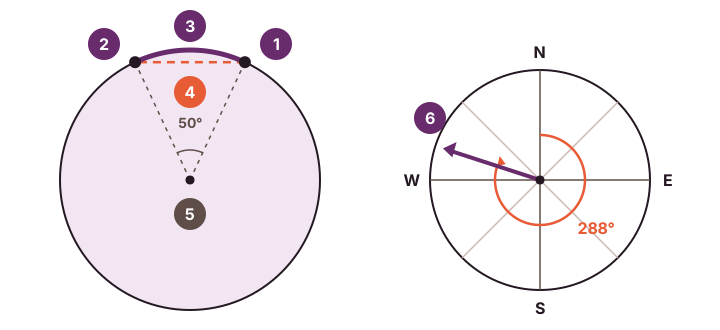
Two panels. Left: a circle for the Earth seen edge-on, with London and New York marked on its rim 50 degrees apart, a thick arc along the rim between them labelled 5,570 km, a dashed straight chord cutting through the inside labelled 5,395 km, and two radius lines of 6,371 km meeting at the centre. Right: a compass rose with N, E, S and W and an arrow pointing at 288 degrees, between west and north-west.

The calculator measures along the curved surface, not through the Earth, and reports the direction you would set off in. For London to New York the arc is 5,570 km and starts at a bearing of 288°.

  1. London, the starting city
  2. New York, the destination
  3. Great-circle distance along the surface: 5,570 km
  4. Straight chord through the Earth, never travelled: 5,395 km
  5. The Earth's centre; both cities are 6,371 km from it and 50.1° apart
  6. Initial bearing: 288°, west-northwest, measured clockwise from north
Hav=sin⁡2ΔLat2+cos⁡Lat1cos⁡Lat2sin⁡2ΔLon2\displaystyle \text{Hav} = \sin^2 \frac{\Delta \text{Lat}}{2} + \cos \text{Lat}_1 \cos \text{Lat}_2 \sin^2 \frac{\Delta \text{Lon}}{2}
Distance=2×R×arcsin⁡Hav\displaystyle \text{Distance} = 2 \times \text{R} \times \arcsin \sqrt{\text{Hav}}
East=sin⁡ΔLoncos⁡Lat2North=cos⁡Lat1sin⁡Lat2−sin⁡Lat1cos⁡Lat2cos⁡ΔLonBearing=atan2⁡(East,North)\displaystyle \begin{gathered} \text{East} = \sin \Delta \text{Lon} \cos \text{Lat}_2 \\[8pt] \text{North} = \cos \text{Lat}_1 \sin \text{Lat}_2 \\ - \sin \text{Lat}_1 \cos \text{Lat}_2 \cos \Delta \text{Lon} \\[8pt] \text{Bearing} = \operatorname{atan2}(\text{East}, \text{North}) \end{gathered}
Flight time=Distance900 km/h\displaystyle \text{Flight time} = \frac{\text{Distance}}{900\ \text{km/h}}

Where:

Lat
— Latitude in degrees, north positive; Lat₁ is the starting city and Lat₂ the destination. ΔLat is Lat₂ − Lat₁.
Lon
— Longitude in degrees, east positive. ΔLon is the destination's longitude minus the starting city's.
Hav
— The haversine of the angle between the two cities as seen from the Earth's centre, a number between 0 (same place) and 1 (opposite sides of the Earth).
R
— The Earth's mean radius, 6,371 km.
Distance
— The great-circle distance in kilometres; dividing by 1.609344 gives statute miles.
East
— The eastward part of the starting direction; negative means westward.
North
— The northward part of the starting direction; negative means southward.
Bearing
— The initial bearing in degrees clockwise from true north. atan2 returns −180° to 180°, so 360° is added to negative results.
Flight time
— Hours a plane would take flying the great circle at a constant 900 km/h, with no taxi, climb, descent or wind.

Worked example

London (51.5072° N, 0.1276° W) to New York (40.7128° N, 74.0060° W), the calculator's default cities. ΔLat is −10.7944° and ΔLon is −73.8784°.

  1. Haversine of the central angle

    0.008847+0.62242×0.75799×0.36116≈0.17924\displaystyle 0.008847 + 0.62242 \times 0.75799 \times 0.36116 \approx 0.17924
  2. Great-circle distance, and in miles

    2×6371×arcsin⁡0.17924≈5570 km≈3461 mi\displaystyle 2 \times 6371 \times \arcsin \sqrt{0.17924} \approx 5570\ \text{km} \approx 3461\ \text{mi}
  3. Initial bearing from East = −0.72818 and North = 0.24125

    atan2⁡(−0.72818,0.24125)+360≈288.3∘\displaystyle \operatorname{atan2}(-0.72818, 0.24125) + 360 \approx 288.3^{\circ}
  4. Straight-line flight time

    5570900≈6.19 h≈6 h 11 min\displaystyle \frac{5570}{900} \approx 6.19\ \text{h} \approx 6\ \text{h}\ 11\ \text{min}

Result

London to New York is 5,570 km (3,461 miles) along the great circle, starting on a bearing of 288°, west-northwest, and about 6h 11m at 900 km/h.

FAQs

How far is London from New York?

The great-circle distance between central London and central New York is 5,570 km, or 3,461 miles. That is the shortest path over the Earth's surface; real flights cover a little more because of airways, weather and wind, and airports sit outside the city centres.

Why does the route to New York start towards the north-west?

The shortest path between two points on a sphere is an arc of a great circle, a circle whose centre is the centre of the Earth. On a flat map it bulges towards the nearer pole. From London the arc to New York leaves at 288°, west-northwest, passes south of Greenland and arrives in New York heading south-west. Going back, the route leaves New York at 51°, north-east, which is not simply the reverse of 288°.

What is the initial bearing?

It is the direction of travel at the start of the great-circle route, measured clockwise from true north: 0° is north, 90° east, 180° south and 270° west. Along a great circle the bearing changes continuously, so it is only the heading you set off on. The compass point rounds it to the nearest of 16 directions, each 22.5° wide.

Is this the driving distance?

No. It is the straight-line distance over the surface, sometimes called the distance as the crow flies. Roads are longer: London to Paris is 344 km in a straight line here, while the drive through the Channel Tunnel is roughly 460 km.

How accurate is the distance?

The haversine formula treats the Earth as a sphere of radius 6,371 km. The real Earth is slightly flattened, so ellipsoid methods such as Vincenty's differ by up to about 0.5%, at most about 28 km on a route as long as London to New York. Each city is a single point at its centre, which matters more for short distances between large cities.

How is the flight time worked out?

It is the distance divided by a constant 900 km/h, a typical airliner cruising speed: 5,570 km takes about 6h 11m. It leaves out taxiing, climbing, descending, wind and routing, so scheduled flights are longer. The Flight Time Calculator adds those allowances and gives the local arrival time.

How to use

Choose two cities to see the great-circle distance, the starting bearing and a rough flight time.

  1. Choose where you startType the first city's name in From and pick it from the list. London is filled in by default.
  2. Choose where you are goingPick the second city in To. The results update as soon as both cities are set.
  3. Read the distanceThe top card shows the great-circle distance in kilometres and in miles, for example 5,570 km (3,461 mi) from London to New York.
  4. Check the direction and flight timeThe table gives the initial bearing in degrees from true north, its compass point, and how long a plane flying straight at 900 km/h would take. Save a scenario to compare several routes.

Assumptions

  • The Earth is treated as a sphere with a mean radius of 6,371 km. Ellipsoid methods differ by up to about 0.5%.
  • Each city is a single point at its centre, so the distance between particular addresses, airports or stations can differ by tens of kilometres.
  • The distance is the shortest path over the surface, not a road, rail or airway route.
  • The flight time assumes a constant 900 km/h with no taxi, climb, descent, wind or detours.

Explore more